What "free" actually means in free software
US$0, US$500 or US$3,400 a year for the same operating system. The ladder is public, and it shows you which line on your software invoice you are really arguing about.
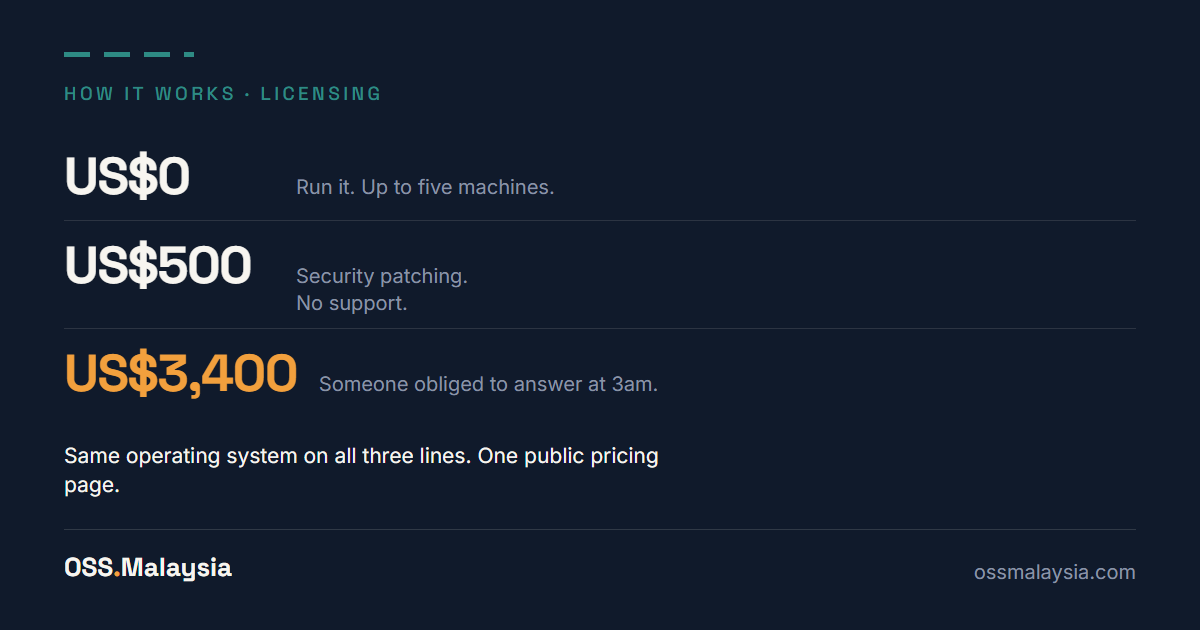
US$0. US$500. US$3,400. Three rungs on one ladder, per machine per year, on Canonical's published pricing page. The operating system is identical on all three. What changes is who is contractually obliged to answer the phone at 3am.
That ladder is the whole argument about "free" software, printed where anyone can read it. When someone says a piece of software is free, a business owner is right to be suspicious — nothing a company depends on is free, somebody is being paid somewhere, and if you cannot see who, you cannot manage the risk. The suspicion is healthy. It is aimed at the wrong word.
"Free" was a claim about permission, not price
The Free Software Foundation has spent three decades explaining this on its own definition page. Think of "free" as in free speech, it says, not free beer.
What you are given is permission: to run it for any purpose, open it up and see how it works, change it, and pass it on. Price is not part of the claim. The page is blunt about the commercial side:
"'Free software' does not mean 'noncommercial.' On the contrary, a free program must be available for commercial use, commercial development, and commercial distribution."
Selling free software is allowed. It always was. The ambiguity is an accident of English, which uses one word where French has libre and gratuit. (Bahasa Malaysia draws the same distinction between bebas and percuma — that is our own observation, not a sourced finding.) We imported the confusion along with the English-language software market.
The word kept sending people to the wrong question, so the industry renamed itself
In the first week of February 1998, weeks after Netscape said it would publish the source code of its browser, a small group in California went looking for a new name. Sources disagree on the day: the Open Source Initiative dates the session to 3 February in Palo Alto; Christine Peterson, who proposed the term, dates the meeting where it was agreed to 5 February. The week is certain; the day is not.
Peterson's reason, in her own words:
"The problem with the main earlier label, 'free software,' was not its political connotations, but that—to newcomers—its seeming focus on price is distracting."
They renamed the whole movement because one word kept sending every new conversation to the wrong question.
The licence gives you nothing to sue over
Here is the fact most enthusiastic write-ups leave out. The MIT License — one of the most widely used software licences in the world — says, in capital letters:
THE SOFTWARE IS PROVIDED "AS IS", WITHOUT WARRANTY OF ANY KIND, EXPRESS OR IMPLIED, INCLUDING BUT NOT LIMITED TO THE WARRANTIES OF MERCHANTABILITY, FITNESS FOR A PARTICULAR PURPOSE AND NONINFRINGEMENT.
Download it, and if it destroys your quarter you have no counterparty. That is not a gap in the licence; it is the licence.
Which is precisely why accountability is sold as a product. A support subscription is largely the purchase of a counterparty — and in Red Hat's case, through its Open Source Assurance programme, one that will stand behind you if a third party claims the code infringes a patent.
What the rungs actually cost
Canonical prints the price of accountability next to the free product (retrieved 21 September 2026). Ubuntu Pro is free on up to five machines for personal use. US$500 per machine per year buys extended security patching on a server, with no support attached. US$3,400 per machine per year is that plus 24/7 support across more than 36,000 packages. These are tiers of one ladder — the top figure is the all-in price, not an addition to the one below it.
Red Hat prices the same idea differently, and the difference matters. Enterprise Linux is itself a paid subscription: US$383.90 a year for self-support, which the store states does not include Red Hat customer support; US$878.90 with business-hours phone support; US$1,428.90 for 24x7 cover on the serious cases. There is no US$0 rung. Rocky and AlmaLinux, the free rebuilds, are separate products, not a cheaper tier of this one.
Nor can you line the two ladders up. Red Hat charges per socket-pair — a pair of processor sockets inside one server — while Canonical charges per machine. Different units, so the numbers are not comparable, however close they look.
These are US list prices on a given date, not a quotation for a Malaysian business. A buyer here transacts through a reseller at a negotiated rate, with SST and the exchange rate on top. We found no ringgit pricing from any vendor, and converting would invent a precision the source does not have.
Where this argument cuts against us
Three concessions, and they are not small ones.
The warranty clause above is the first. For anything you download and run without a subscription, there is genuinely no counterparty.
The second is who maintains the code. The Linux Foundation and Harvard's Laboratory for Innovation Science surveyed the software the world depends on and found that "136 developers were responsible for more than 80% of the lines of code added to the top 50 packages." For an unpaid component, "the community will fix it" can mean a handful of people with day jobs. That is the honest answer to "who supports it" — and exactly why support contracts exist.
The third is interoperability, and it is the one that bites a smaller business hardest. Your software choice is not only yours. If your auditor, your bank, your customs broker and your largest customer all exchange files in one format, the cost of being the odd one out lands on you, not on them. Munich moved roughly 15,000 of its 18,000 city desktops to Linux, then voted in 2017 to move back; the reported reasons were organisational rather than technical — staff unable to run programs they needed, and friction exchanging files with other agencies. Every cost figure attached to that story is either self-reported or vendor-commissioned, so we quote none of them.
The ringgit savings figures everyone quotes do not survive their sources
If you have been in a Malaysian open-source conversation, you have heard a number.
The Edge Malaysia in June 2007 reported savings of "some RM48 million in terms of licensing fees alone". Linux Journal in January 2009, citing MAMPU's own newsletter, reported RM40 million. If those are meant as cumulative savings they cannot both be right, and nobody quoting them says which they are. Later secondary reports escalate to much larger figures, which we could not trace to a source at all, so we are not printing them.
All of it traces back to MAMPU self-reporting. None is audited. All count licence fees only, ignoring implementation, migration and training. All are over fifteen years old. A finance lead who checks one number and finds it hollow stops believing the other nine.
The scepticism cuts both ways: almost every published comparison of total cost was paid for by a party with a side, and whether open source works out cheaper depends on your site, not on a study.
The actual decision
You are never choosing between paying and not paying. You are choosing which line on the invoice — licence, or support and implementation — and who picks up the phone when it breaks.
With proprietary software those are usually bundled, and often quoted as one number. Your ERP vendor may itemise maintenance as a percentage of the licence; if so, ask what the licence line alone buys you. With open source they arrive unbundled, so the split is visible by default. That is uncomfortable, because it puts a price on something you were getting without being told what it cost. It is also the honest advantage.
Sometimes you will look at the split and decide the paid product is worth it. Some of them are. Make that call with the numbers in front of you, not on the strength of a word that never meant what you thought it meant.
If you want a second opinion on your own invoice, that is what we built the community for — Malaysian owners comparing what they actually pay, and the builders who set these systems up. Come and ask in the WhatsApp group.
Sources
- The Free Software Definition, Free Software Foundation
- Christine Peterson, "How I coined the term 'open source'"
- History of the Open Source Initiative
- The MIT License
- Ubuntu Pro pricing, Canonical
- Red Hat Enterprise Linux Server store
- Red Hat Open Source Assurance
- Linux Foundation and Harvard LISH, Census II summary, March 2022
- Wikipedia, "LiMux"
- The Register, Munich Windows migration, 24 Nov 2017
- The Edge Malaysia, "Mampu accelerates open source", issue 758, June 2007
- Linux Journal, "Malaysian Government Saves Big with Open Source", 13 Jan 2009
Researched and drafted with AI, reviewed and published by a human.